How Wellness Programs Support Mental Health in the Workplace
Workplace wellness programs now play a measurable mental health role, from reducing burnout risk to improving flexibility, screening access, and employee trust.
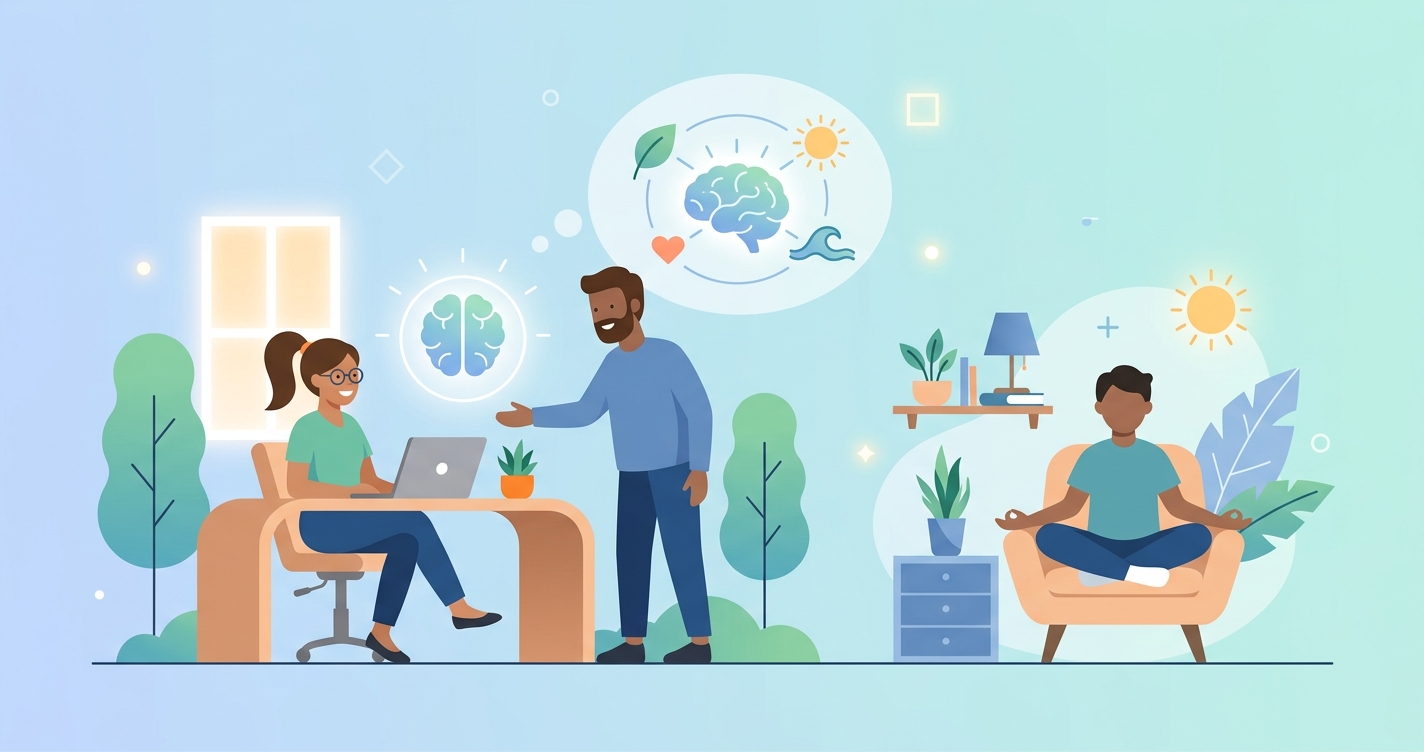
Mental health has moved from the edge of workplace wellness to the center of it. That shift is partly cultural, but mostly economic. Employers are staring at burnout, turnover, absenteeism, and claims inflation all at once. In that environment, wellness programs are no longer judged by whether they offer a meditation app or an annual seminar. They are judged by whether they reduce friction in daily work life, surface risk earlier, and make support feel normal instead of awkward. That is why wellness programs mental health workplace conversations now sound more like operating strategy than perks strategy.
"Employees who work at a company that supports their mental health are twice as likely to report no burnout or depression." — Mind Share Partners and Qualtrics, 2025 Mental Health at Work Report
Why wellness programs mental health workplace strategy changed
A few years ago, many employers treated mental health support as a benefits add-on. Offer an employee assistance program, mention it during onboarding, and hope people remember it exists when they need help. That model has aged badly.
The World Health Organization reported that depression and anxiety lead to an estimated 12 billion lost working days every year, costing the global economy about $1 trillion in lost productivity. WHO also notes that poor working conditions, low job control, discrimination, and excessive workloads are direct mental health risks. In other words, the problem is not just whether counseling is covered. It is whether the day-to-day experience of work quietly wears people down.
That is why the strongest wellness programs now do three things at once:
- reduce avoidable stress in the employee experience
- make support easier to access without stigma
- give employers better population-level visibility into emerging risk
The last point matters more than many HR teams expected. Once mental health became a board-level topic, leadership stopped asking whether support was available and started asking whether anyone was actually using it, whether burnout was moving, and whether certain teams were at higher risk than others.
| Wellness model | What it usually includes | Mental health impact | Main weakness |
|---|---|---|---|
| Legacy benefits-only model | EAP, hotline, annual communications | Limited | Low awareness and low trust |
| perk-based wellness model | meditation app, resilience webinar, challenge program | Moderate for engaged employees | Often misses high-risk groups |
| integrated well-being model | manager training, flexibility, mental health benefits, screening, analytics | Higher and more durable | Requires cross-functional ownership |
| data-informed digital wellness model | integrated support plus digital screening and engagement tracking | Best for early detection and broad reach | Needs privacy-safe design and clear rollout |
What workers actually say they need
Employee preference data has become pretty consistent. Workers want practical support before they want inspirational messaging.
The 2024 Workplace Wellness Survey from the Employee Benefit Research Institute and Greenwald Research found that work-life balance was the top benefit priority for 56% of workers, followed by flexibility in work schedules at 48%. The same survey found that 69% of employees were interested in employer-provided mental health benefits. That mix tells a useful story. Employees do want mental health support, but they also see scheduling control and workload design as mental health support.
Mind Share Partners' 2025 national report lands in the same place. Workers said good work-life balance and flexibility would help more than most formal benefits. They also reported a stubborn stigma problem: 46% said they would worry about losing their job if they talked openly about mental health at work.
This is where many wellness programs still miss. They invest in resources but ignore the social conditions around those resources. If an employee thinks using support will mark them as unstable or uncommitted, utilization stays low no matter how many vendors are in the benefits portal.
How wellness programs support mental health in practice
The phrase "mental health support" sounds broad because it is. In practice, the most effective workplace programs usually combine several levers rather than betting on one.
Flexibility and job control
WHO's guidance on mental health at work is unusually direct: low job control, inflexible hours, and excessive workload are risk factors. So when employers add schedule flexibility, give employees more predictability, or redesign staffing levels, they are not doing culture work in the abstract. They are reducing known mental health stressors.
This is also why manager behavior matters so much. A flexible policy with a manager who quietly punishes people for using it is not really a flexible policy.
Early engagement instead of crisis-only support
Older workplace mental health models waited until someone was already struggling. Newer programs try to create more frequent, lower-friction touchpoints. That can include pulse surveys, digital check-ins, manager training, benefit navigation, and screening workflows that make employees more aware of their overall health status before problems escalate.
For corporate wellness teams, this is where biometric and digital health screening fit the picture. Screening is not mental health treatment, and it should never be sold that way. But it can support mental health strategy by widening engagement, making health conversations more routine, and giving employers a better view of stress-related population patterns when used in privacy-safe, aggregated ways.
Normalizing use
The biggest barrier is often not access. It is fear.
When a program is framed as something only struggling employees use, adoption drops. When the same support is built into normal benefits communication, leadership messaging, annual wellness campaigns, and manager practices, it starts to feel ordinary. That shift sounds small, but it is the difference between a dormant EAP and an actual support system.
Where digital wellness programs fit
Corporate wellness used to rely heavily on in-person events: health fairs, screenings, lunch-and-learns, occasional counseling referrals. Those still have a role, but they are a poor match for distributed workforces and deskless employees.
Digital wellness programs help in three ways:
- they reach employees outside headquarters
- they create shorter, repeatable touchpoints instead of once-a-year events
- they make it easier to combine communication, screening, incentives, and follow-up in one flow
That matters for mental health because inconsistency is the enemy. A program that only reaches office-based staff leaves out shift workers, field teams, and remote employees, who often face different stress profiles.
| Program element | Direct mental health effect | Operational benefit for employers |
|---|---|---|
| Flexible scheduling tools | lowers daily stress and work-family conflict | improves retention and shift coverage planning |
| Manager training | reduces stigma and improves escalation pathways | creates more consistent employee experience |
| EAP and therapy navigation | improves access to professional support | increases benefit utilization |
| digital biometric screening | broadens wellness engagement and makes health check-ins easier | improves participation across remote and multi-site teams |
| population-level reporting | identifies high-stress groups earlier | helps target budget and interventions |
A digital screening platform is especially useful in organizations that struggle with participation. Mental health support cannot be isolated from the rest of the wellness experience. If employees already avoid health fairs, ignore enrollment emails, and miss annual screenings, the program has a reach problem before it has a clinical problem. A simpler phone-based experience gives employers another way to get people into the ecosystem.
For companies already rethinking their screening model, posts like Digital Biometric Screening for Open Enrollment: How It Works and Year-Round Wellness vs Annual Screening: Which Drives Better Outcomes? are useful reference points.
Current research and evidence
The recent evidence base is clearer than the old "wellness may help" language that used to dominate this category.
Afaf Khalid and Jawad Syed wrote in Human Resource Management Review in 2024 that mental health at work affects employees at individual, team, and organizational levels. Their systematic review covered 341 studies and argued that mental health outcomes are shaped not just by personal resilience but by job design, leadership, and organizational systems.
A 2024 workplace review published in the Indian Journal of Occupational and Environmental Medicine reached a similarly practical conclusion: poor employee mental health is associated with lower satisfaction, weaker performance, burnout, and higher occupational risk, while stronger well-being is linked to productivity and better social functioning.
Business Group on Health's 2025 Employer Well-being Strategy Survey found that 100% of surveyed employers now include mental health in their well-being strategy. That is remarkable on its face, but it also reveals a new problem. Mental health is universal in strategy decks; execution quality still varies wildly.
The strongest signal may still come from Mind Share Partners and Qualtrics. Their 2025 Mental Health at Work Report found that employees at companies supporting mental health were twice as likely to report no burnout or depression. That is not proof that any single vendor or program caused the result. But it is strong evidence that a supportive workplace environment changes the employee experience in ways people can feel.
Industry applications
Employers with distributed workforces
Remote-first and multi-location employers often discover that mental health support is uneven by geography. Headquarters employees know what is available. Everyone else hears about it late, or not at all. Digital wellness infrastructure helps level that out.
Manufacturing and shift-based workforces
Mental health support for shift workers is usually less about app content and more about predictability, access windows, supervisor behavior, and low-friction health engagement. If the program assumes everyone works 9 to 5 at a laptop, it will fail.
Benefits brokers and consultants
For brokers, mental health strategy has become a differentiation issue. Employers increasingly want a vendor stack that combines screening, incentives, navigation, and measurable reporting rather than disconnected point solutions. That is one reason digital wellness platforms are showing up more often in RFP discussions.
The future of workplace mental health programs
The next phase of workplace wellness will probably look less like a bundle of apps and more like an operating system for workforce health. Mental health will stay central, but the winning programs will connect it to flexibility, manager capability, financial stress, physical screening, and population analytics.
I think that is the right direction. Employees do not experience burnout in neat vendor categories. They experience it as a pileup: bad sleep, financial stress, unclear expectations, low autonomy, skipped checkups, and a sense that asking for help could backfire. Programs built around real life tend to outperform programs built around procurement categories.
That is also why solutions like Circadify are finding a place in broader wellness strategy. The value is not that a biometric screening replaces mental health support. It does not. The value is that easier, phone-based health engagement gives employers a better way to reach more employees, reduce participation friction, and build a year-round wellness model that supports both physical and mental well-being.
Frequently asked questions
Do wellness programs really improve employee mental health?
They can, but the better question is which parts of the program actually change daily work life. Research increasingly points to flexibility, supportive managers, low-stigma access to care, and consistent engagement as the pieces that matter most.
Is an employee assistance program enough on its own?
Usually not. EAPs still matter, but they work better when paired with strong communication, manager training, flexible work practices, and a broader wellness structure employees encounter regularly.
How does health screening connect to mental health strategy?
Health screening is not treatment for anxiety, depression, or burnout. Its role is operational. It helps employers increase wellness participation, normalize regular check-ins, and spot population-level stress patterns when data is handled in aggregated, privacy-safe ways.
What should employers measure first?
Start with participation, benefit awareness, work-life balance sentiment, manager trust, and repeat engagement. Claims and retention matter too, but they move more slowly. Early operational signals usually show whether the program is reaching people at all.