
Phone-Based Biometric Screening vs Onsite Health Fairs: Cost Comparison for 2027
A 2027-ready cost comparison of phone-based biometric screening vs onsite health fairs, covering labor, participation, logistics, and data workflow tradeoffs.
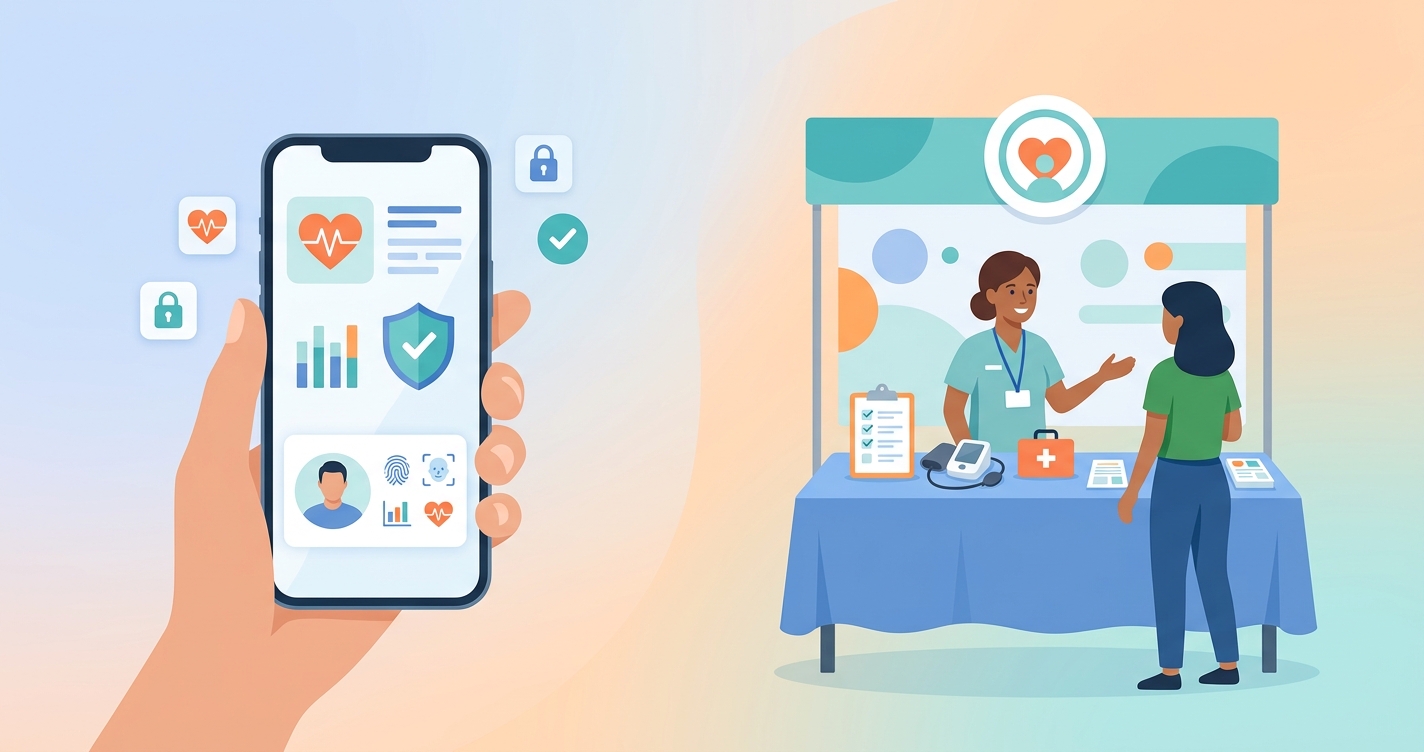
For benefits leaders planning 2027 budgets, the real question is no longer whether digital screening belongs in the mix. It is whether phone biometric screening vs onsite health fair economics now favor a different operating model. The answer, in most cases, is yes. Traditional health fairs still offer visibility and a once-a-year enrollment moment, but their cost structure is heavy: staffing, scheduling, space, travel, lost work time, and delayed data handoffs. Phone-based screening changes the math by shifting the program from an event to a workflow.
Employers have been moving in this direction for a while. RAND's workplace wellness study found that fewer than half of employees in surveyed firms completed a clinical screening or health risk assessment, and the report specifically noted that convenience and accessibility were major factors in participation. That finding matters more in 2026 than it did in 2013 because the workforce is more distributed, hourly labor is more expensive, and benefits teams are under more pressure to show operational ROI, not just wellness intent.
"Making wellness activities convenient and accessible for all employees" was one of RAND's core facilitators of program success in its workplace wellness study. In plain English: the easier the screening is to complete, the better the economics usually look.
Phone biometric screening vs onsite health fair: where the cost difference starts
An onsite health fair is usually priced as a single event, but the event price hides the full employer cost. The vendor invoice may cover biometric collection, setup, and reporting, yet internal costs sit elsewhere: HR coordination time, facilities support, manager scheduling, employee downtime, no-show rescheduling, and the lag between screening day and follow-up outreach.
Phone-based screening shifts those costs around. It lowers or removes event setup, travel, and floor-time disruption, while increasing dependence on software workflow, employee communications, and digital completion support. That does not mean phone-based screening is automatically cheaper in every case. It means the cost base becomes more variable, more scalable, and usually easier to align with a distributed workforce.
The participation problem is central here. In the JAMA randomized trial led by Zirui Song, Kevin Volpp, and Katherine Baicker in 2019, employee participation in surveys and screenings at intervention worksites ran about 36% to 45%. That is a useful reality check for any employer still assuming an onsite event will reach everyone. A fair that misses shift workers, remote staff, field teams, or employees who simply do not want to stand in line is not cheap just because the invoice looks familiar.
A transparent 2027 cost comparison model
Public research does not give employers many apples-to-apples price sheets for onsite fairs versus phone-based biometric screening. What it does provide is enough evidence to compare the operating cost categories honestly.
The table below uses a cost-structure lens rather than pretending there is one universal market price.
| Cost category | Onsite health fair | Phone-based biometric screening | Likely 2027 direction |
|---|---|---|---|
| Vendor staffing | High; nurses, phlebotomy, event crew, setup labor | Low to moderate; support staff and platform operations | Favors phone-based |
| Facilities and space | Requires conference rooms, plant space, or mobile setup | Usually none beyond normal employee environment | Favors phone-based |
| Employee time away from work | Concentrated and visible; lines and appointment blocks | Shorter sessions, distributed over time | Favors phone-based |
| Travel and multi-site coordination | High for dispersed employers | Minimal | Favors phone-based |
| Completion support | Simple in-person assistance | Digital reminders and tech support required | Mixed |
| Data turnaround | Often batch-based after event close | Faster, workflow-based ingestion | Favors phone-based |
| Reach to remote and deskless workers | Weak unless multiple events are added | Stronger if smartphone access is high | Favors phone-based |
| Repeat measurement during the year | Expensive to repeat | Relatively low marginal cost | Favors phone-based |
| Engagement visibility | Strong "event day" presence | Less visible, requires communications discipline | Favors onsite |
| Scalability across locations | Operationally heavy | Much easier to scale | Favors phone-based |
The practical takeaway is simple: onsite fairs have a fixed-event cost profile, while phone-based screening has a platform-and-workflow cost profile. If an employer wants one annual visibility moment for a largely on-premise workforce, onsite fairs can still make sense. If the employer wants repeated measurement, broader reach, and lower disruption, phone-based models usually win.
A related issue is device access. Pew Research Center reported in 2025 that 91% of U.S. adults own a smartphone. That does not eliminate access gaps, especially in older, lower-income, or highly regulated workforces, but it does mean the delivery infrastructure for phone-based screening is already in employees' pockets. For benefits teams, that matters because hardware adoption is often the hidden budget killer in digital health programs.
Where onsite health fairs still make financial sense
There are still settings where onsite fairs remain defensible.
- Large single-campus employers with stable shifts
- Organizations that tie screening to open enrollment or benefits fairs
- Workforces that expect in-person coaching or screenings as part of culture
- Employers that want a visible launch event before moving to a digital model
Those cases share one trait: the employer gets enough attendance density to justify the setup costs. A headquarters campus with 2,000 employees in one place looks very different from a service business with 300 sites and a lot of turnover.
For the latter, onsite economics fall apart fast. Every extra location adds coordination cost. Every missed shift requires another screening window. Every fair becomes a one-day snapshot that has to be translated later into outreach, coaching, and care navigation. By the time those pieces are added, the health fair is less a screening program than a logistics exercise.
Industry applications for 2027 benefit design
Employers with distributed workforces
This is the clearest use case for phone-based screening. Multi-location employers pay a penalty every time they try to centralize a program that should be portable. If screening can happen through a phone workflow, the program reaches headquarters staff, remote employees, and field workers without duplicating event costs in every geography.
Employers focused on year-round engagement
If the goal is not just to identify risk but to keep employees involved after the first touchpoint, phone-based screening has an advantage. It can be repeated quarterly or connected to challenges, incentives, and care management workflows. That is much harder with health fairs, where the entire program often peaks on one day and then goes quiet.
Benefits brokers building a 2027 cost story
Brokers increasingly need more than a participation estimate. They need a labor and operations story. The strongest argument for phone-based screening is not that it feels modern. It is that the employer can cut coordination burden, shrink lost work time, and collect data in a format that is easier to route into follow-up programs.
Current research and evidence
The evidence base does not yet contain a giant randomized trial called "phone-based biometric screening vs onsite health fairs." What it does contain is a set of findings that point in the same direction.
RAND researchers Soeren Mattke, Hangsheng Liu, and colleagues found that convenience, accessibility, and incentive design strongly influence completion in wellness programs. Their employer survey work reported that only 46% of employees in surveyed firms completed a clinical screening or health risk assessment. That is a warning against assuming event-based access will produce universal uptake.
Song, Baicker, and colleagues reported in JAMA in 2019 that participation in workplace wellness surveys and screenings reached roughly 36% to 45% at intervention worksites. The study is often cited for its limited clinical and spending effects over 18 months, but the participation data is just as important for budgeting. A screening model that depends on employees showing up at one place and one time inherits an attendance ceiling.
On the technology side, Yuta Sugita and coauthors wrote in Sensors in 2021 that camera-based remote photoplethysmography is a low-cost, non-contact method suitable for telemedicine, while also noting that lighting, frame rate, and motion conditions matter. A 2024 review of deep learning and rPPG-powered contactless physiological measurement reached a similar conclusion: camera-based vitals capture is promising, but deployment quality depends on workflow and environment, not just the algorithm.
That is probably the most useful way to read the research. Phone-based screening is not magic. It is a cheaper operating model when the employer can support the workflow properly. Onsite fairs are not obsolete. They are just expensive when used as a substitute for ongoing access.
The future of phone biometric screening vs onsite health fair decisions
By 2027, most employer decisions in this category will be less about screening itself and more about what kind of program architecture the employer wants.
A fair-based model is built around annual campaigns. A phone-based model is built around distributed access, lower marginal screening cost, and faster data flow. Employers that still need a flagship onsite moment may keep one. Many others will move toward hybrid design: a visible launch event for awareness, then phone-based screening for reach, repeat measurement, and follow-up.
That hybrid model also fits how benefits programs are being purchased now. Finance teams want fewer one-off events and more systems that can scale without proportional labor growth. Benefits leaders want better access across remote, deskless, and part-time populations. And employees usually prefer the option that feels less disruptive.
Frequently asked questions
Is phone-based biometric screening always cheaper than an onsite health fair?
Not always. For a single large site with high attendance density, an onsite fair can still be cost-effective. Phone-based screening usually becomes cheaper when the workforce is distributed, repeat screening is needed, or employer labor tied to scheduling and coordination is high.
What costs are most often missed in onsite health fair budgets?
The common blind spots are employee time away from work, internal HR coordination, facilities support, rescheduling, and the follow-up workload after event day. Those costs may not appear on the vendor invoice, but they still hit the employer.
Does phone-based screening work better for remote workers?
Usually yes, because access is not tied to being in the right building on the right day. Pew's 2025 data showing 91% smartphone ownership in the U.S. makes this model more practical than it was even a few years ago.
What is the smartest 2027 strategy for most employers?
For many employers, it will be a hybrid strategy: use an onsite event only where it adds real value, then rely on phone-based screening for broader reach, repeated measurement, and lower operating friction across the year.
If your team is rethinking event-based screening, start with the operating model rather than the tech label. Compare labor hours, participation reach, repeat-measurement costs, and follow-up speed. That usually makes the answer clearer. For employers moving toward digital screening workflows, solutions like Circadify are part of the broader shift toward phone-based, contactless health measurement. You can also read our analysis of biometric screening ROI and year-round wellness vs annual screening for a wider budget view.