
How Multi-Location Employers Standardize Health Screening
How multi-location employers standardize health screening across sites, with data on consistency, participation, vendor design, and digital screening models.
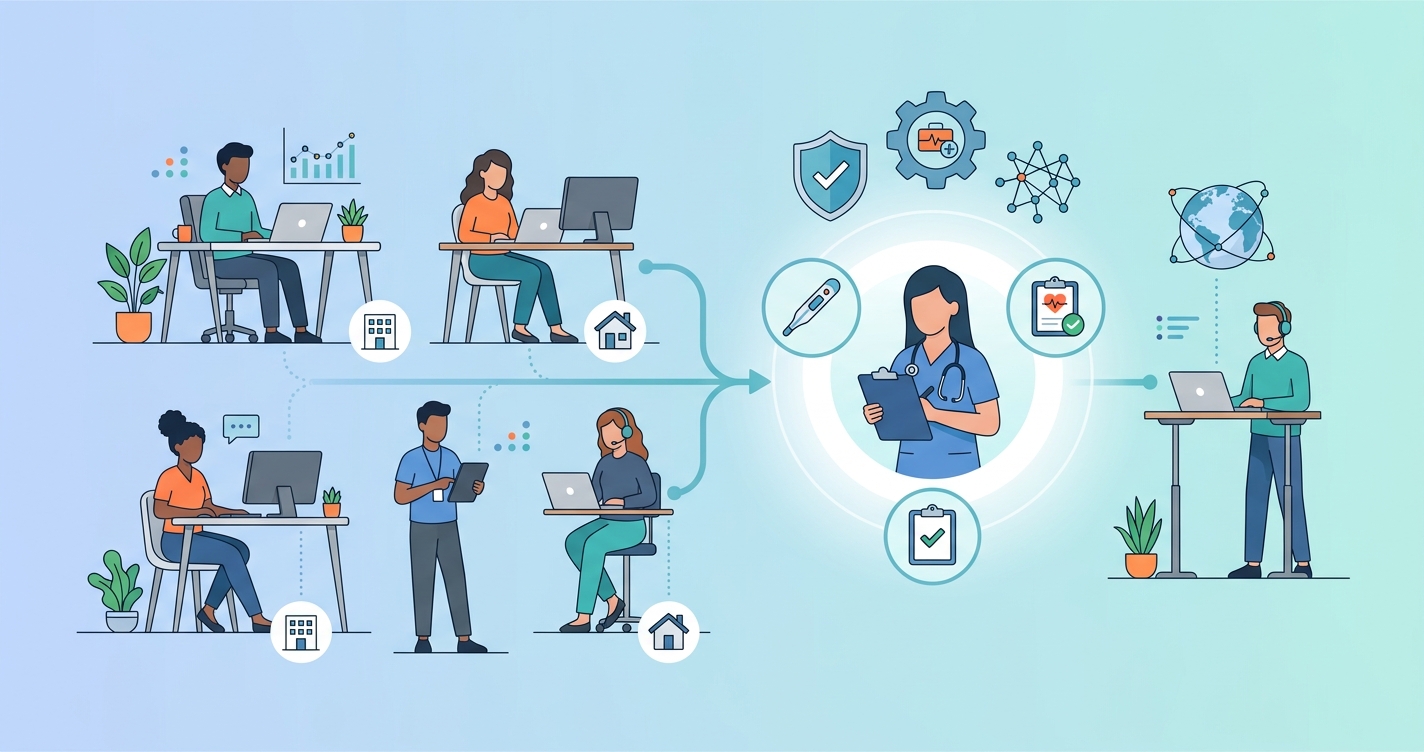
Multi-location employer health screening usually breaks down in the same place: one office gets a polished program, another gets a stripped-down version, and remote workers get a link nobody opens. That inconsistency matters more than many HR leaders expect. The standard employers are trying to set is not just clinical. It is operational. The screening has to feel like the same program whether an employee works in a headquarters tower, a warehouse, a retail branch, or from a kitchen table two states away.
"The main challenges that employers face in establishing a global consistency strategy are employees' diverse needs, lack of local support or budget, and lack of providers able to deliver relevant solutions around the world." — Business Group on Health, 2025 Employer Well-being Strategy Survey
Why multi-location employer health screening becomes an operations problem
Most employers do not struggle to explain why screening matters. They struggle to run the same experience everywhere. HERO's biometric screening consensus statement, developed with committee co-chairs Chris Behling and Rebecca Kelly, argued that screening design has to account for location mix, privacy, incentives, workflow, and integration into a broader health management program. In other words, the screening event itself is only the visible part of the problem.
That lines up with what the research on participation has shown for years. Economists Damon Jones, David Molitor, and Julian Reif found in the Illinois Workplace Wellness Study that financial incentives can raise screening completion, but the effect levels off quickly and does not solve the deeper issue of who is actually engaged. If one region has onsite clinics and another depends on mailed instructions and local labs, incentive dollars do not erase the gap.
Mercer's 2025 Health on Demand research adds another wrinkle. In its US survey of more than 2,000 employees, 29% said they had delayed care in the prior two years for financial reasons, while 19% cited trouble navigating the system and another 19% said they could not take time off work. That matters for screening programs across dispersed workforces. Standardization fails when access depends on schedule flexibility, local manager support, or whether an employee happens to live near a participating clinic.
The models employers use to standardize screening
There is no single operating model, but the strongest programs usually choose one primary delivery method and then build narrow exceptions around it rather than the other way around.
| Screening model | How it works across locations | Main strength | Main weakness | Best fit |
|---|---|---|---|---|
| Onsite event model | Nurses or mobile teams visit each location on a schedule | Familiar and highly visible | Expensive, uneven across small sites, weak for remote workers | Large campuses and plants |
| Voucher and local-clinic model | Employees complete screening through partner labs or clinics | Broad geographic reach | Experience varies by market and provider | Distributed white-collar workforces |
| Hybrid model | Onsite at large sites, vouchers elsewhere | Better coverage than onsite-only | Administrative complexity grows fast | Employers with mixed workforce density |
| Phone-based digital screening | Employees complete core screening from their own device | Consistent access, lower logistics burden, easier repeat cadence | Requires digital readiness and strong communication | Remote, field, and multi-location populations |
What usually separates a workable program from a messy one is not the vendor deck. It is whether the employer made a few blunt decisions early:
- Which measures are required everywhere versus optional
- What the employee journey looks like in every region
- How incentives are triggered and verified
- Where accommodations sit for workers without easy digital access
- Which system owns the final record of participation
Without those decisions, "flexibility" turns into site-by-site improvisation.
Where standardization actually breaks
The obvious failure point is geography, but it is rarely the only one.
Eligibility rules drift by site
Large employers often let local business units modify timelines, incentive amounts, or approved vendors. The result is that the same employer may quietly run three different screening programs under one brand name. Employees notice that quickly, especially when one site receives paid time to complete screening and another is told to do it off-hours.
Manager behavior determines uptake
A standardized program on paper can still become a local culture problem. In field operations, store networks, and manufacturing environments, first-line managers decide whether employees get time, reminders, and social permission to participate. If that layer is not aligned, standardization stops at the slide deck.
Data arrives in different formats
This is the problem benefits teams underestimate. One screening partner sends structured data. Another sends PDFs. Another only confirms completion. Employers can standardize messaging and incentives while still ending up with fragmented reporting. That makes year-over-year comparison shaky and site-level benchmarking even worse.
For that reason, many teams reviewing year-round wellness vs annual screening are starting to judge programs less by event attendance and more by how reliably the data can feed population health analysis.
What a standardized screening architecture looks like
The employers that do this well usually build a common architecture instead of a collection of events.
A practical design has four layers:
- A single screening policy with common measures, deadlines, and incentive rules
- One employee-facing workflow that looks the same across locations
- A unified participation and results feed for reporting
- A fallback path for workers who cannot use the default route
That last point matters. Standardization does not mean forcing identical conditions onto very different workforces. It means setting one default experience and defining exceptions clearly. A deskless worker on a night shift and a benefits-eligible remote employee will not engage the same way, but they can still move through the same program logic.
| Architecture layer | What to standardize | What can vary locally |
|---|---|---|
| Policy | Eligibility, measurement set, deadlines, incentives | Language localization, scheduling windows |
| Access | Portal or app entry point, identity verification, consent flow | Device support and accommodation path |
| Operations | Reminder cadence, completion rules, reporting fields | Local escalation contacts |
| Analytics | Participation dashboards, trend reporting, completion definitions | Site-specific intervention plans |
Industry applications across different workforce types
Corporate and headquarters populations
For office-heavy employers, the challenge is usually convenience rather than reach. Employees can complete a screening, but if the process takes too long or feels disconnected from benefits enrollment, participation drops. This is where digital-first screening often works best because the workflow can sit inside broader wellness and enrollment communication.
Retail and branch networks
Branch-heavy employers need consistency across dozens or hundreds of small sites that cannot justify dedicated onsite events. Voucher models used to be the default answer, but they often create uneven employee experiences. A standardized digital model reduces that variation, especially when the program is linked to the same incentive structure at every branch.
Manufacturing and field operations
These groups need short sessions, mobile access, and clear accommodation rules. The problem is not just technology. It is time control. If the screening only works during business hours and the workforce is on staggered shifts, the "standard" program will mostly measure who had the easiest schedule.
Remote and hybrid workforces
Remote populations expose every weakness in event-based screening. Employers that already looked at digital biometric screening for open enrollment have seen this firsthand: once the workforce becomes distributed, a process built around one room and one date stops scaling.
Current research and evidence
The Illinois Workplace Wellness Study remains one of the most useful warnings for employers chasing participation through incentives alone. Damon Jones of the University of Chicago, David Molitor of the University of Illinois, and Julian Reif of the University of Illinois found that paying employees to complete screenings increased completion rates, but the program did not change healthcare spending after one year. The bigger insight was selection: workers who chose to participate already had lower medical spending before the intervention.
HERO's consensus statement on biometric health screening for employers made a different but complementary point. The organization argued that successful screening programs depend on goals, population makeup, screening measures, implementation logistics, privacy safeguards, and evaluation design. For multi-location employers, that reads less like a clinical checklist and more like an operating manual.
Mercer's 2025 Health on Demand report, drawing on a US survey of more than 2,000 employees, showed why standardization now has to account for access barriers outside the workplace too. Sixteen percent of employees said they were not confident they could afford needed care, and nearly a third had delayed care for financial reasons. When a screening program assumes spare time, easy transportation, or a nearby clinic, those barriers become participation bias.
Business Group on Health's 2025 Employer Well-being Strategy Survey sharpened the global version of the same issue. Employers said the hardest part of building consistent programs was balancing diverse employee needs with local budget and vendor limitations. That is the core tradeoff in multi-location screening: consistency cannot rely on local heroics.
The future of multi-location employer health screening
The old model treated standardization as a procurement project: sign one national vendor, publish one communication calendar, and hope the footprint behaves. That is not enough anymore. The next phase looks more like platform design. Employers want one workflow, one reporting layer, and one participation logic that works whether the employee is onsite, mobile, or remote.
That is why phone-based screening keeps getting attention. It shifts the hard part away from coordinating nurses, pop-up clinics, and travel calendars, and toward a simpler question: can the employer deliver one repeatable experience to everyone? Solutions like Circadify are part of that shift, giving employers a way to think about screening as a distributed digital process instead of a chain of local events.
Standardization is not glamorous. It is mostly workflow design, exception handling, and reporting discipline. But that is exactly why it matters. In a workforce spread across many locations, the employers that win are not the ones with the most elaborate screening event. They are the ones whose program still works when there is no event at all.
Frequently asked questions
What does standardized health screening mean for a multi-location employer?
It means employees across sites follow the same core rules for eligibility, timing, measures, incentives, and reporting, even if the delivery method includes a few accommodations for specific workforce groups.
Why do multi-location screening programs become inconsistent?
They usually drift because local sites use different vendors, different communication habits, different paid-time policies, or different data formats. The inconsistency is often operational before it is clinical.
Is onsite screening still the best option for distributed employers?
Usually not by itself. Onsite events can work well at large campuses, but they create coverage gaps for small branches, field workers, and remote staff. Most distributed employers need either a hybrid design or a digital-first model.
How often should employers review a standardized screening program?
At minimum, after each screening cycle. The review should cover participation by location, completion barriers, data quality, accommodation usage, and whether incentives were applied consistently.