How to Run Biometric Screening for a Fully Remote Workforce
A research-backed look at how employers run biometric screening for a fully remote workforce, including operating models, participation design, compliance concerns, and vendor selection criteria.
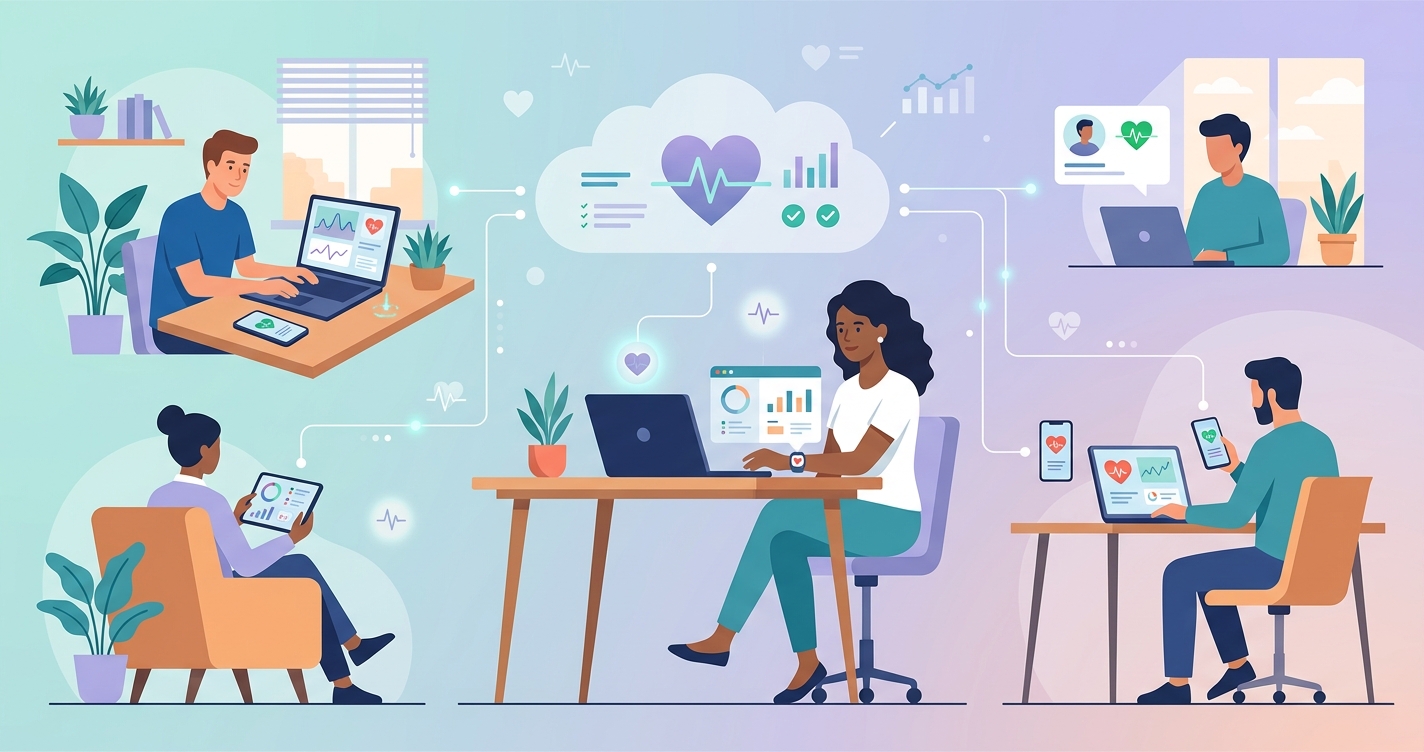
For employers with people spread across states, time zones, and home offices, biometric screening is no longer a one-day event in a conference room. It has become an operating question. How do you collect useful health data when there is no headquarters, no annual onsite fair, and no realistic way to ask everyone to show up in the same place? That is why biometric screening fully remote workforce strategies now sit much closer to benefits operations than to workplace programming. The job is not to recreate the old onsite model on a laptop. It is to design a system that remote employees will actually complete, that HR can administer without chaos, and that gives employers data in time to use it.
"Hybrid working from home improves retention without damaging performance," wrote Nicholas Bloom, Ruobing Han, and James Liang in Nature (2024), a finding that matters for wellness leaders because the workforce structure itself is no longer temporary. If remote and hybrid work are durable, screening systems have to be durable too.
What biometric screening for a fully remote workforce actually requires
Remote biometric screening works best when employers stop treating it like an event and start treating it like a distributed workflow. In practice, that means creating a screening window, offering more than one completion path, and making results easy to route back into benefits, wellness, or care-management systems.
A remote workforce changes the screening problem in three ways. First, location stops being predictable. Second, employee schedules become more fragmented. Third, participation rises or falls based on convenience rather than office visibility. Saeed Amirabdolahian, Guy Pare, and Stefan Tams wrote in their 2025 Journal of Medical Internet Research meta-review that digital wellness programs perform best when they fit naturally into employee routines rather than forcing separate behavior. That point sounds obvious, but many employers still run remote screening as if people are waiting for a corporate event invite.
The most effective models usually combine three elements:
- A 30- to 60-day screening window instead of a single screening date
- Multiple completion options, such as at-home kits, partner labs, or contactless phone-based tools
- Automated results delivery to the employer's wellness or benefits platform
That structure matters because remote work changes participation psychology. Lynnette-Natalia Lyzwinski's 2024 scoping review in the Journal of Occupational Health found that isolation, schedule fragmentation, and uneven home environments all affect engagement with employer programs. A remote employee does not get the social prompt of seeing coworkers line up outside a screening room. If the process takes too many steps, many simply drop off.
Comparing remote biometric screening models
| Model | How it works | Best fit | Main tradeoff |
|---|---|---|---|
| National lab network | Employees book with a partner lab near home | Broad U.S. workforce with stable access to lab locations | Good clinical familiarity, but completion can slip if travel is inconvenient |
| At-home collection kit | Kit is mailed to employee and returned for processing | Remote teams that value flexibility and privacy | Convenient, but kit return rates depend on reminders and support |
| Contactless phone-based screening | Employee completes a guided scan on a smartphone camera | Fast participation pushes, open enrollment, large distributed populations | Strong convenience, but employers still need clear workflow and consent design |
| Hybrid model | Employees choose between lab, kit, or digital option | Employers with varied job types and geographies | Most inclusive, but requires more vendor coordination |
For most remote employers, the hybrid model wins because distributed workforces are rarely uniform. A software engineer in San Diego, a sales rep in Atlanta, and a field manager in rural Montana do not have the same access, habits, or expectations. One pathway almost always leaves somebody out.
Why the old onsite logic breaks in remote settings
Traditional screening programs were built around logistics that remote companies do not have: office traffic, fixed schedules, shared communication channels, and physical reminders. Those programs depend on momentum. People walk by a sign-up table, hear colleagues talking about incentives, or finish a screening because they are already in the building.
Remote work strips out those defaults. Nicholas Bloom and his coauthors showed in Nature that hybrid work is now a durable arrangement for a huge share of knowledge workers. That should change how employers think about screening design. Remote screening is not a temporary accommodation for an unusual workforce. It is the baseline model for many employers now.
The evidence around workplace wellness is useful here too. In the Illinois Workplace Wellness Study, Damon Jones, David Molitor, and Julian Reif found that wellness programs reliably increased health screening rates, even when broader medical-spending effects were harder to prove. For employers, that is an important distinction. Screening is still operationally valuable even if nobody should pretend it solves every population-health problem on its own. It gives benefits teams a way to identify risk, support incentives, and connect employees to next steps.
In remote settings, that means the program should be designed around completion rather than ceremony.
- The shorter the employee journey, the better the completion rate
- Reminder cadence matters more than event marketing
- Mobile-first workflows usually outperform desktop-only enrollment
- Result turnaround time affects whether screening data is actually used
Industry applications for remote workforce screening
Remote biometric screening is showing up in a few common employer situations, and each one has different operational priorities.
Open enrollment and incentive programs
For employers that tie wellness incentives to screening completion, timing matters more than almost anything else. Remote workers need enough time to complete the process before benefits deadlines. That is one reason digital models are replacing one-week campaigns. A longer screening window gives employees room to act without turning HR into a help desk.
This is also where distributed employers overlap with the issues discussed in Digital Biometric Screening for Open Enrollment. If results arrive after enrollment closes, the screening becomes informational at best and frustrating at worst.
Remote-first culture and year-round wellness
Fully distributed companies often want screening to support an ongoing health strategy rather than a once-a-year ritual. In those cases, the better question is not "How do we replicate the onsite fair?" It is "How do we create a low-friction health touchpoint that fits a remote employee's life?" That is the same shift described in How Remote-First Companies Run Effective Wellness Programs, where the core issue is program architecture, not just communication.
Multi-state employers and benefits brokers
Benefits brokers and consultants increasingly need screening vendors that can handle different state privacy expectations, varied employee access, and mixed workforce types. Remote screening is not just a wellness product choice. It becomes a vendor-management and compliance choice. The more distributed the population, the more the screening model has to be standardized behind the scenes while staying flexible for the employee.
Current research and evidence
The strongest current evidence does not say that every remote screening program works. It says that digital and distributed wellness models work better when they are designed around accessibility and behavior.
Amirabdolahian, Pare, and Tams reviewed 29 studies on digital wellness programs and concluded that employer-provided digital wellness interventions show promising efficacy and acceptability across stress, physical activity, weight management, and other domains. For corporate wellness leaders, the practical read is simple: digital delivery is no longer the weak substitute. In many settings, it is the operating model.
Lyzwinski's 2024 review adds an important caution. Remote work can increase isolation and reduce the informal social support that often nudges employees into participating. That means remote screening programs cannot rely on passive awareness. They need direct communication, clear deadlines, and low-friction support.
Bloom, Han, and Liang contribute something else that matters here. Their randomized trial at Trip.com found that hybrid work reduced attrition by one-third and improved satisfaction without hurting performance. If employers are building around hybrid and remote work for the long term, then wellness infrastructure has to follow that same long-term logic. A screening model built around office presence will age badly.
Jones, Molitor, and Reif add a useful operational benchmark from the Illinois Workplace Wellness Study. Their trial showed that workplace wellness programs can meaningfully raise screening rates even when downstream cost effects are mixed. That result is often misunderstood. Screening is still useful because it creates data, touchpoints, and actionability. Employers just need to be honest about what the program is for: better engagement, better visibility, and better routing into benefits or care pathways.
The future of remote biometric screening
The direction of travel is pretty clear. Employers are moving away from single-modality screening and toward flexible systems that give workers choices. Some will still prefer a lab. Others will complete a mailed kit. Many will favor phone-based options because they feel faster and easier to fit into a normal day.
The next shift is integration. Remote screening will matter more when results move directly into enrollment workflows, health coaching, or population-health analytics instead of sitting in a disconnected vendor portal. Corporate wellness buyers are also becoming less patient with programs that require manual reconciliation across vendors. In a distributed workforce, admin friction scales faster than participation gains.
That is why the best remote screening programs usually look boring in the right way. They are easy to launch, easy to complete, and easy to manage. Employees do not need to think much about the workflow. HR does not need a spreadsheet army. Brokers can explain the model in one conversation.
Frequently asked questions
What is the best biometric screening model for a fully remote workforce?
Usually a hybrid model. A single completion path leaves gaps. Employers with national or multi-state workforces tend to do better when employees can choose between a lab visit, an at-home kit, or a digital option.
How long should a remote biometric screening window stay open?
Most employers need at least 30 days. For open enrollment or incentive-heavy programs, 45 to 60 days is usually safer because employees in remote roles often complete tasks closer to deadlines.
Does remote biometric screening work for employees in different states?
Yes, but only if the workflow is designed for distributed operations. Vendors need to support broad geographic coverage, clear consent flows, secure results handling, and a process that does not assume office attendance.
How should employers measure success?
Completion rate is the first metric, but not the only one. Employers should also track turnaround time, percentage of incomplete kits or abandoned bookings, employee support volume, and how often results are actually used in wellness or benefits workflows.
For employers trying to modernize biometric screening for distributed teams, the real goal is not to imitate the old onsite event. It is to build a screening system remote employees will finish and HR can run without friction. Solutions such as Circadify are emerging to support that shift with phone-based, scalable screening experiences built for today's workforce.